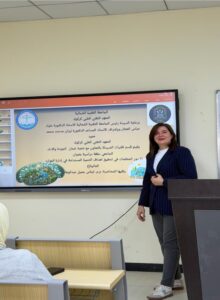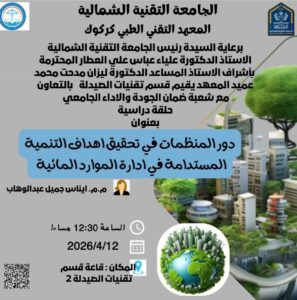
Presenter: M.M. Enas Jameel Abdulwahab
Department: Pharmacy Technologies
The concept of sustainable development is a fundamental one, based on achieving a balance between economic, social, and environmental aspects. It aims to meet the needs of the present generation without compromising the ability of future generations to meet their own needs. This concept is particularly evident in the field of water resources management, especially in water-scarce countries like Iraq.
Organizations of all types—international, governmental, private sector, and civil society organizations—play a crucial role in achieving Sustainable Development Goal 6, which focuses on clean water and sanitation. These entities contribute to supporting governments in developing integrated water resources management policies and plans, and they work to enhance cooperation between countries regarding shared water resources.
These organizations also provide data and modern technologies that help improve water use efficiency, particularly in the agricultural sector, through technologies such as remote sensing. Furthermore, they support innovation in finding alternative water sources, such as desalination, treated wastewater reuse, and rainwater harvesting, which contributes to reducing pressure on traditional resources. The role of organizations is not limited to the technical aspect alone, but extends to raising environmental awareness and promoting a culture of water conservation, whether through awareness campaigns or by integrating sustainability concepts into the work of institutions and companies.
This seminar aims to clarify the importance of the role of organizations in achieving sustainable development in the field of water management, and to increase the awareness of students and professionals on this topic, while focusing on the challenges facing Iraq and proposing practical solutions that can be implemented to ensure the sustainability of water resources for future generations.