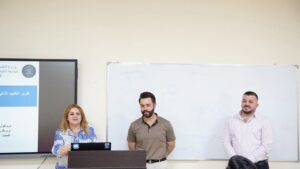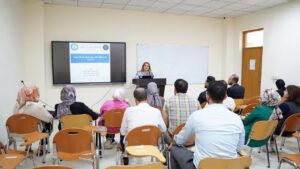
Under the patronage of the President of the Northern Technical University, Professor Dr. Alia Abbas Ali Al-Attar, and under the supervision of Assistant Professor Dr. Lizan Madhat Muhammad (Dean of the Institute), the Quality Assurance and University Performance Division at Kirkuk Technical Medical Institute organized a scientific course titled “Writing an Improvement Plan for a Laboratory Self-Assessment Report”
The course was attended by:
Assistant Professor Kul Jemin Madhat
Assistant Professor Yildirim Fikret Abdul Razzaq
Mr. Ali Muhammad Ali Taqi
Course Introduction:
This course helps participants practically understand the concept of self-assessment and its importance as a diagnostic tool for identifying strengths and opportunities for improvement within the laboratory. It also focuses on how to analyze evaluation results in an objective, scientific manner, leading to the development of an improvement plan based on clear priorities and measurable, actionable objectives.
The course covered:
First: General Objectives
– Analysis of self-assessment results
– Identifying strengths and opportunities for improvement
– Formulating a practical and implementable improvement plan in accordance with accreditation standards.
Second: The main topics of the course
The course on writing an improvement plan for a laboratory self-assessment report highlights the importance of transforming self-assessment results into a realistic and systematic action plan aimed at improving laboratory performance and achieving accreditation and quality requirements. During the course, participants learn about the concept of self-assessment and its role in measuring a laboratory’s compliance with quality standards. They also learn how to analyze its results scientifically to help identify strengths, improvement opportunities, and gaps between the current status and desired requirements. The course also explains how to formulate a clear improvement plan, including identifying areas that need development, setting measurable goals, and specifying appropriate improvement actions, timelines, and performance indicators to track progress. It also addresses methods for monitoring the implementation of the plan and evaluating the impact of improvement on laboratory performance to ensure sustainable development.
Course conclusions:
Self-assessment is an essential tool for identifying strengths and development opportunities, and developing an effective improvement plan is a pivotal step in raising performance quality and achieving accreditation requirements. It also demonstrates that the success of the plan depends on clear objectives, defining responsibilities, and monitoring implementation to ensure continuous improvement, which enhances laboratory efficiency and beneficiaries’ confidence in its results.