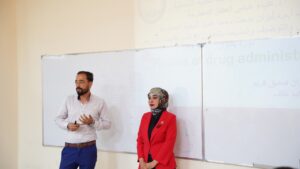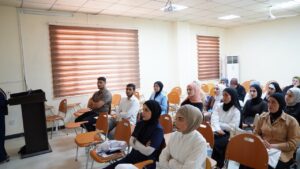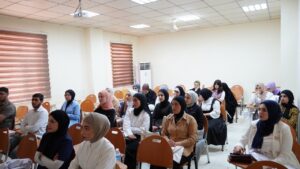
Under the patronage of the esteemed President of the Northern Technical University, Professor Dr. Alia Abbas Ali Al-Attar, and under the supervision of Assistant Professor Dr. Lizan Medhat Muhammad, Dean of the Technical Medical Institute, the Rehabilitation, Employment, and Follow-up Unit, in cooperation with the Department of Nursing Technology, organized a scientific course titled “Routes of Drug Administration”
*:- Presented at the course
1- Asst. M. Sazan Siddiq Karim
2- Asst. M. Mohammed Hakim Khalaf
*:- The course included
Of course! Here is a simplified explanation of an educational course on Routes of Drug Administration, which can be presented to healthcare providers or nursing students.
Course Title: Routes of Drug Administration – Understanding and Proper Practice
Course Objectives:
Understand the different types of drug administration routes.
Distinguish between routes based on speed of action and absorption efficiency.
Identify the advantages and disadvantages of each method.
Learn safety procedures and precautions to take when administering medications.
Practical training on some common routes. Course Topics:
1. General Introduction to Medication
Definition of Medication and Its Effects
Factors Influencing the Choice of Administration Route
2. Main Routes of Medication Administration:
A. Oral
Most Common Route.
Types of Dosage Forms: Tablets, Capsules, Syrup.
Advantages: Easy and Safe.
Disadvantages: Slow Absorption, Interaction with Gastric Enzymes.
B. Parenteral Routes
Subcutaneous: Such as insulin.
Intramuscular: Such as vaccinations.
Intravenous: Faster Absorption – For Emergency Situations.
Advantages: Rapid Effect.
Disadvantages: Requires Medical Skill and Must Be sterilized.
C. Rectal Route
When unable to swallow.
Such as suppositories.
Advantages: An Effective Alternative in Some Cases.
Disadvantages: Irregular Absorption.
D. Topical/Transdermal Routes
Such as creams and patches. Advantages: Local or systemic action (patch).
Disadvantages: Slow absorption.
E. Other routes:
Inhalation: Asthma.
Sublingual: Rapid absorption – such as angina medication.
In the eye/ear/nose (local application): Local action.
—
Workshop:
Training in subcutaneous and intramuscular injections.
Oral medication administration techniques for children and the elderly.
Correct application of transdermal patches.